Several speakers noted that Budget carried the weight of expectations.

Beside manufacturing, deceleration was also witnessed in sectors like agriculture, construction and electricity, gas and water supply.
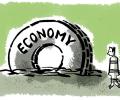
As he projected a grim outlook for the economy, RBI Governor said that amidst this encircling gloom, agriculture and allied activities have provided a beacon of hope on the back of an increase of 3.7 per cent in foodgrains production to a new record.

Sanjeev Nayyar offers a roster of things to do to see the India of our dreams.
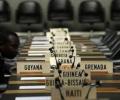
India continues to apply import quotas on marble.

Panagariya also stressed that India must continue the liberalisation of its top tariff rates and the country should not revert back to import substitution.
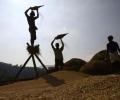
The agriculture sector has witnessed feeble growth on account of drought for two successive years

Loan waivers will never be enough. Reforming the agricultural marketing system is essential to addressing the concerns of farmers in a sustainable manner, says Nitin Desai.

Nationalisation has served its purpose. It's time to move ahead, keeping majority ownership of the government in a few banks to serve the people, argues Tamal Bandyopadhyay.

The government has been waiting for the expansion by the private sector, Finance Minister Nirmala Sitharaman said while reminding India Inc of various measures including corporate tax rate cut, policy consistency, ease of doing business, among others to facilitate investment.
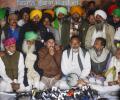
Reading out a reply to the government's talks offer during a press conference, farmers leaders said that they are ready for dialogue with an open mind if they get a concrete proposal, but made it clear they will not accept anything less than a complete repeal of the three agriculture laws and legal guarantee for minimum support price (MSP).
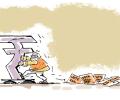
'We have promised to ensure reduced tax rates.'

India's GDP estimates for 2020-21 show that the economy is expected to perform much better than earlier projections by different agencies, indicating a sustained V-shape post-lockdown recovery, experts said. The first Advance Estimates (AE) by the National Statistics Office (NSO) has projected a contraction of 7.7 per cent in the real GDP during 2020-21. This was better than the projections by certain international agencies like the IMF and World Bank.
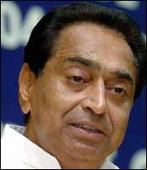
The comprehensive foreign trade policy provides for setting up free trade warehousing zones and gives major thrust to service exports.

'Igniting in this country, a false feeding of nationalism combined with religion.' 'They are promoting the religion of the majority people in the country to feed their political agenda.'

Commerce and Industry Minister Kamal Nath said on Saturday that India now must gear up for agricultural exports apart from export of manufactured goods and services.

No government can 'ignore inclusiveness in a democracy', Montek Singh Ahluwalia tells Anjuli Bhargava.

The Indian economy appears to have slowed down in 2018-19 due to lower private consumption, tepid growth in fixed investment and muted exports, a finance ministry report has said.

The Biden administration should expect continuity in Iran's policies under Raisi. This may not necessarily mean that strengthening of ties with the West will be Raisi's top priority, observes Ambassador M K Bhadrakumar.

'The committee was confident that the recommendations will pave the way to resolve the ongoing farmers' agitation'

Ten central trade unions except Bharatiya Mazdoor Sangh are observing one-day general strike on Thursday to protest against various government policies.
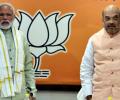
Corporate leaders said a stable government at the Centre will help boost infrastructure spend, address agricultural distress, and encouraging employment.

The restoration of the Chilahati-Haldibari railway link and signing of the pacts, providing for cooperation in areas of hydrocarbons, agriculture and textiles among others, came at a virtual summit between Prime Minister Narendra Modi and his Bangladeshi counterpart Sheikh Hasina.

Bollywood stars Akshay Kumar, Ajay Devgn, filmmaker Karan Johar and Suniel Shetty on Wednesday said citizens should focus on the government's efforts to resolve the ongoing farmer crisis rather than paying attention to "half truths" and those "creating differences."

Change will have to begin with Mr Modi, who by all accounts has shown little active interest in macro-economic issues, preferring instead to focus on the effective implementation of projects and programmes, points out T N Ninan.

However, Icra Rating Principal Economist Aditi Nayar feels that the numbers are a bit too optimistic and need real heavy-lifting by the Centre and the states. "The survey forecasts on real and nominal GDP will require a substantial push from Central and state spending as private sector capacity expansion is anticipated to be intermittent, and sector-specific in the next couple of quarters," she said. Nayar added that private consumption is likely to chart a differentiated recovery across income and age groups. Based on the comments made in the Survey, she expects the Union Budget to incorporate a growth in gross tax revenue of 15-16 per cent.
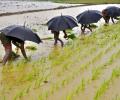
'By 2020 around 34% of India's population will be in the 15-34 age group.' 'More than 70% of them live in rural areas.' 'Their energy and enthusiasm need to be tapped in order to meet their aspirations and transform agriculture and the rural economy,' says P K Joshi.
The two countries agree to work together on the scientific, technical, and policy aspects of biofuels development, production, and use. These areas include biomass production and sustainability, conversion technologies, bio-based products, and rural development strategies.

The Budget emphasises on capacity building and empowerment of marginalised sections of society including farmers.
In a statement in Hindi, she said governments and their leaders who ignore public sentiments in a democracy cannot govern for long and it is now quite clear that the protesting farmers will not bow in the face of the Centre's policy of 'tire and pushover'.

Is the worst over for Indian banks? The past two years saw them ride on treasury trades as deposits soared and credit growth dipped sharply. Gross and net non-performing assets (NPAs) moved south, and the provision coverage ratio (PCR), capital buffers, and profitability indicators are back at pre-pandemic levels. So, what's the plot ahead?
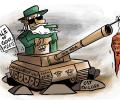
The promise of a less suspicious government is surprising. What about the disconnect between the new business stance and earlier push to dictate the narrative in politics and public life, wonders T N Ninan.

The President in his address to the joint sitting of Parliament unveiled the policies and priorities of the Bharatiya Janata Party-led National Democratic Alliance government which assumed power last month after elections to the 16th Lok Sabha.

'The prospect is of a self-confident and self-sustaining India will make it a more effective player in the global arena,' External Affairs Minister Dr Subrahmanyam Jaishankar points out delivering the Sardar Patel Lecture-2020: India and the Post-Covid World.
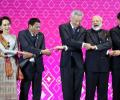
The prime minister also welcomed convergence of views between India and ASEAN for cooperation in the Indo-Pacific region.

'The new government will have to contend with slowing economic growth, weak private investment, anaemic exports and vulnerable external imbalances, a stressed financial system, mounting fiscal pressures (including high government debt-to-GDP ratios) and an exceptionally bad employment situation,' says Shankar Acharya, former chief economic adviser to the Government of India.

The government should have mentioned clearly the specific structural reforms that were responsible for the deviation from the fiscal deficit target by half a percentage point, says A K Bhattacharya.

Sharad Pawar says final draft will go to Cabinet before Tuesday.

Thirteen years after their small car project was forced out of West Bengal following the anti-land acquisition movement in Singur, Industry and IT Minister Partha Chatterjee has said talks are on with the Tatas for big-ticket investments in the state. Underscoring job creation as the TMC government's top priority, Chatterjee also said incentives to companies will depend on ability to generate employment. He said the Mamata Banerjee dispensation wants two large manufacturing units to be set up by any prominent industrial house at the earliest. "We never had any enmity with the Tatas, neither we fought against them. "They are one of the most respected and biggest business houses of this country and also abroad. "You can't blame the Tatas (for the Singur fiasco).

Finance Minister Nirmala Sitharaman on Monday presented the Budget for 2021-22 in the Lok Sabha that is expected to provide relief to the pandemic-hit common man as well as focus more on driving economic recovery through higher spending on healthcare, infrastructure and defence amid rising tensions with neighbours, As India emerges from the COVID-19 crisis, the ninth Budget under the Modi government, including an interim one, is widely expected to focus on boosting spending on job creation and rural development, generous allocations for development schemes, putting more money in the hands of the average taxpayer and easing rules to attract foreign investments.
 © 2026 Rediff.com - Advertise with us - Disclaimer - Privacy Policy - Sitemap - Feedback - About us - Terms of use - Grievances